-
The Pizza Model for AI
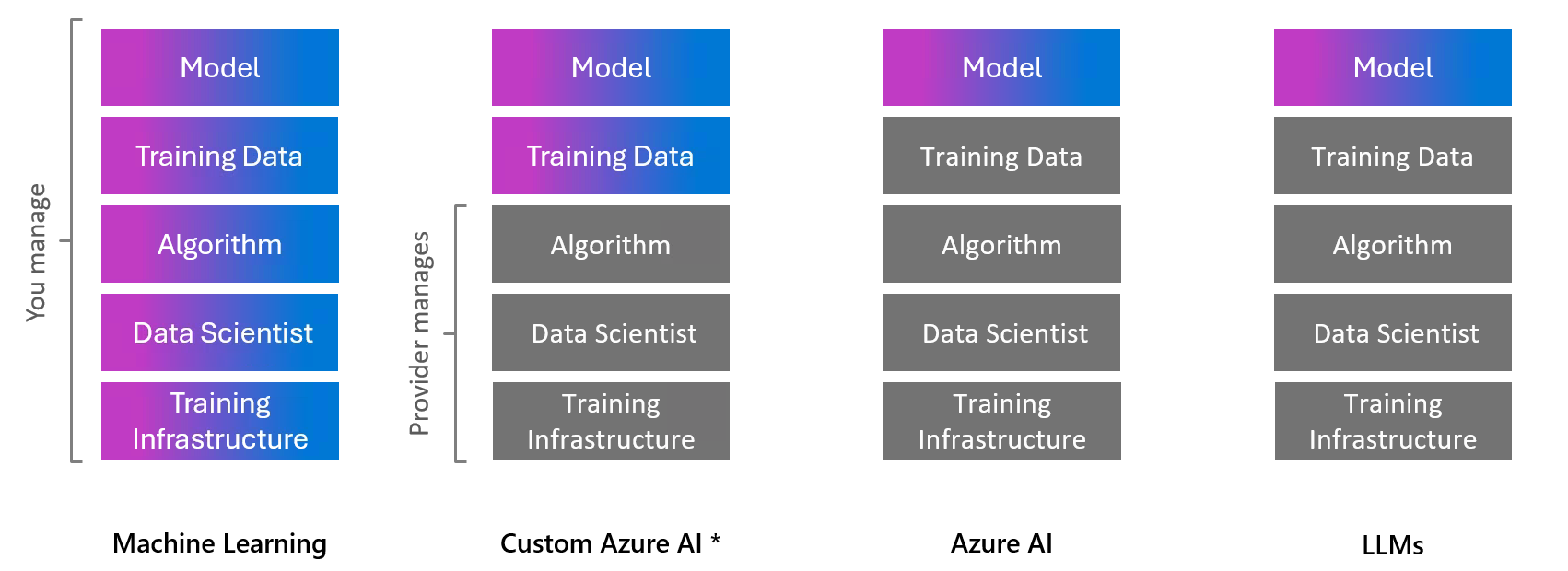 The Pizza Model for AI takes inspiration from the world of cloud computing, where services are often categorized into three main models: IaaS, PaaS and SaaS.
 -
Azure OpenAI: multi application and scale architectures
Azure OpenAI Service is a cloud-based platform that allows you to access and deploy powerful AI models based on OpenAI technologies, such as GPT-4. In this post, we will explore how to use the provisioned throughput (PTU) feature of Azure OpenAI Service, and how to design architectures for scalable and multi-application scenarios that leverage Large Language Models (LLMs).
-
Home Assistant: Map Card, displaying Weather and Other Tile Layers
 Displaying a weather map in Home Assistant got easier using ha-map-card and it’s support for multiple Tile Layers. My open-source project
 ha-map-cardprovides a a new lovelace card, serving as an enhancement to the native Home Assistant map-card, bringing a host of advanced features like custom tile layers, entity display options. It is built on leaflet. In version0.4.0some new options are introduced to enable multiple Tile Layers, we are going to use this to visualize a Cloud map using OpenWeatherMap. -
Installing NixOS on a Surface Go 1
The Microsoft Surface Go 1, with its compact size and versatility, used to be an excellent choice for users seeking a portable computing solution. Unfortunately the performance is as is it’s size, limited. My goal is to have a useable tablet sized linux device.
-
Azure AI Speech: Text to Speech, improving pronunciations with AI
Azure AI Speech, a cloud-based service offered by Microsoft Azure, has been at the forefront of Text-to-Speech (TTS) capabilities. Text-to-Speech technology has come a long way from its early, often robotic-sounding, iterations. With advancements in deep learning and neural networks, AI has played a pivotal role in refining the naturalness and expressiveness of synthesized voices. Azure Speech employs Neural Text-to-Speech (Neural TTS), a cutting-edge technology that utilizes deep neural networks to model the complex patterns and nuances of human speech. This approach enables the synthesis of high-quality, natural-sounding voices that closely mimic the cadence, intonation, and rhythm of human speech. While the results are generally very good sometimes there are some challenges with person- and location- names in Dutch. Luckily Azure AI Speech supports fine-tuning speech output with Speech Synthesis Markup Language (SSML).